 Exbio Βιολογια και Κοινωνια

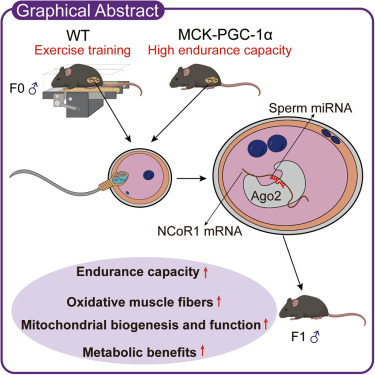
Paternal exercise influences exercise capacity and metabolic health of offspring, but the underlying mechanisms remain poorly understood. We demonstrate that offspring sired by exercise-trained fathers display intrinsic exercise adaptations and improved metabolic parameters compared with those sired by sedentary fathers. Similarly, offspring born to transgenic mice with muscle-specific overexpression of peroxisome proliferator-activated receptor γ coactivator-1α (PGC-1α), a booster of mitochondrial function, exhibit improved endurance capacity and metabolic traits, even in the absence of the inherited PGC-1α transgene. Injecting sperm small RNAs from exercised fathers into normal zygotes recapitulates exercise-trained phenotypes in offspring at the behavioral, metabolic, and molecular levels. Mechanistically, exercise training and muscular PGC-1α overexpression remodel sperm microRNAs, which directly suppress nuclear receptor corepressor 1 (NCoR1), a functional antagonist of PGC-1α, in early embryos, thereby reprogramming transcriptional networks to promote mitochondrial biogenesis and oxidative metabolism. Overall, this study underscores a causal role for paternal PGC-1α, sperm microRNAs, and embryonic NCoR1 in transmitting exercise-induced phenotypes and metabolic adaptations to offspring.
Διαβάστε το πλήρες άρθρο: https://www.cell.com/cell-metabolism/fulltext/S1550-4131(25)00388-2